Profaqua is an organization registered in the scientific culture section of the culture at School program of the Quebec Ministry of Education and Higher Education.

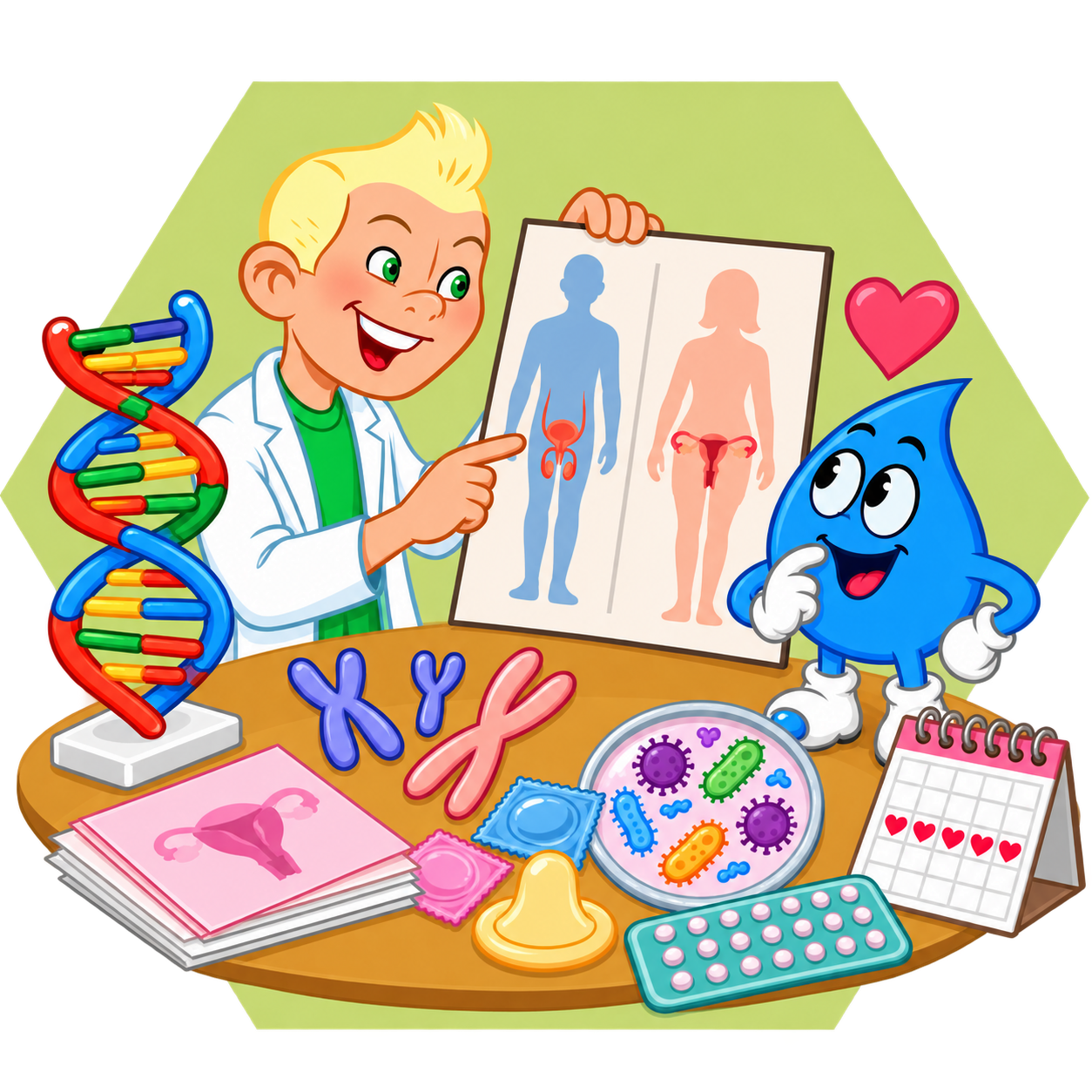
Sexual Health Education
Understanding your body, reproduction, and sexual health!
How does reproduction work? How is genetic information passed on? How are sexually transmitted infections transmitted? How can we reduce risks and prevent pregnancy?
Through five or six interactive stations, students explore different aspects of human sexuality, reproduction, and sexual health. They learn about reproduction and fertilization, DNA and genetics, sexually transmitted infections, situations involving transmission risks, prevention and contraception, as well as anatomy and the changes associated with puberty.
Through models, games, hands-on activities, and real-life scenarios, students are encouraged to observe, think critically, make connections, and develop their understanding of their bodies and health.
A hands-on and interactive science workshop that explores human sexuality through biology, anatomy, genetics, and prevention, in an educational context adapted to the school environment.
Objectives at the elementary level:
- Identify the main structures and functions of the reproductive systems.
- Understand the main stages of reproduction and fertilization.
- Discover basic concepts related to DNA, chromosomes, and heredity.
- Recognize some sexually transmitted infections and understand the main ways to prevent them.
- Distinguish between situations that involve a risk of STI transmission and those that do not.
- Identify the main physical changes associated with puberty.
Objectives at the secondary level:
- Describe the main stages of human reproduction, from the formation of gametes to fertilization.
- Explain the role of chromosomes, DNA, and genetic information in the transmission of traits.
- Distinguish between the different types of pathogens that can cause STIs, including viruses, bacteria, and parasites.
- Understand the main modes of STI transmission and methods of prevention.
- Understand the proper use of condoms and the role of different contraceptive methods.
- Identify the main structures of the reproductive organs and explain some of the physiological changes associated with puberty.
Additional details
| Type of service | |
|---|---|
| Customer type | |
| Duration | |
| Categorie |
Our needs
- If there is limited time between workshops, we strongly recommend having all workshops in the same room.
- For a 60-minute workshop, five teams must be formed before the facilitator arrives.
- For a 75-minute workshop, six teams must be formed before the facilitator arrives.
Important information
- For a 60-minute workshop, students rotate through five teams, sharing tasks and taking on different challenges.
- For a 75-minute workshop, students rotate through six teams, sharing tasks and taking on different challenges.
- A minimum of two in-school groups is required.
Additional charges
- For this workshop, an additional $10 + tax fee for chemical supplies will be added to your cart.
- Travel fees (minimum $25) apply depending on the distance.
- For 60-minute workshops, if more than five groups are scheduled, the workshops will be spread over more than one day and the travel fees will be adjusted accordingly.
- For 75-minute workshops, if more than four groups are scheduled, the workshops will be spread over more than one day and the travel fees will be adjusted accordingly.
- A $60 fee will be charged if there is a delay of more than 90 minutes between two workshops.
205.00$ – 256.00$
You may also like…

Profaqua
Profaqua
Services
Turnkey activities
Nous rejoindre
Registered in the scientific culture section of the Culture at School program.
Our partners

Profaqua is an organization registered in the scientific culture section of the culture at School program of the Quebec Ministry of Education and Higher Education.