Profaqua is an organization registered in the scientific culture section of the culture at School program of the Quebec Ministry of Education and Higher Education.

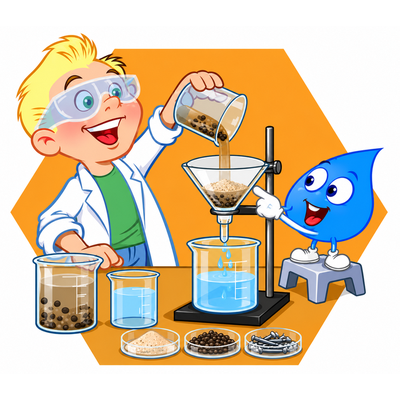
Mixtures and Separation
A mixture… but how can we separate it?
Can the components of a mixture be separated without causing a chemical reaction?
Through a series of hands-on science challenges, students explore different properties of matter and use them to separate mixtures. They investigate density, particle size, magnetism, and solubility to discover how scientists can isolate the different components of a mixture.
Students will observe, make predictions, conduct experiments, and choose the most appropriate technique to solve different separation challenges.
A hands-on and interactive way to understand the difference between a mixture and a compound, while discovering several separation techniques used in science and industry.
Objectives at the elementary level
- Distinguish between mixtures, pure substances, and compounds.
- Understand that the components of a mixture can be separated using their physical properties.
- Discover different techniques for separating mixtures, including filtration, sieving, decantation, flotation, and magnetic separation.
- Understand how density and particle size can be used to separate the components of a mixture.
- Observe, make predictions, and choose an appropriate method to solve a separation problem.
- Experiment with different separation techniques through hands-on and interactive science challenges.
Objectives at the Secondary level
- Distinguish between a pure substance, a mixture, and a compound.
- Explain how the components of a mixture can be separated using their physical properties, without causing a chemical reaction.
- Choose an appropriate separation technique based on the properties of the components of a mixture.
- Explain the role of properties such as density, particle size, magnetism, and solubility in separation processes.
- Analyse a mixture and justify the choice of a separation method based on its properties.
- Make connections between the separation techniques explored in the classroom and their applications in science, industry, and everyday life.
Additional details
| Type of service | |
|---|---|
| Customer type | |
| Duration | |
| Categorie |
Our needs
- A sink must be accessible near the classrooms where the workshops take place.
- If there is limited time between workshops, we strongly recommend having all workshops in the same room.
- Six teams must be formed before the facilitator arrives.
Important information
- A minimum of two in-school groups is required.
- The workshop consists of six teams that share tasks and challenges. Coloured clips are used to identify each student.
Additional charges
- For this workshop, an additional $15 + tax fee for chemical supplies will be added to your cart.
- Travel fees (minimum $25) apply depending on the distance.
- For 60-minute workshops, if there are more than five groups scheduled, the workshops will be spread over more than one day and the travel fees will be adjusted accordingly.
- A $60 fee will be charged if there is a delay of more than 90 minutes between two workshops.
205.00$ – 300.00$
You may also like…

Profaqua
Profaqua
Services
Turnkey activities
Nous rejoindre
Registered in the scientific culture section of the Culture at School program.
Our partners

Profaqua is an organization registered in the scientific culture section of the culture at School program of the Quebec Ministry of Education and Higher Education.